
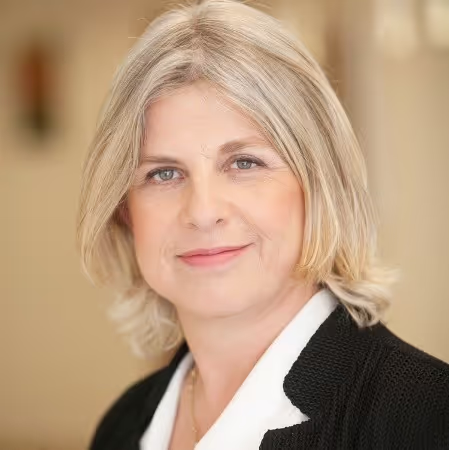
In this interview, Will Lockwood, Senior Editor at Pharmacy Technology Management Review, talks withProfessor Varda Shalev, M.D., Managing Partner at Team8 and healthcare informatics pioneer, about the opportunities for applying AI in healthcare generally, and pharmacy specifically.
Will Lockwood: Varda, let’s start out with the big picture. What’s the impact that AI can have in healthcare
Prof. Varda Shalev, M.D.: We have a huge opportunity now with AI in healthcare, because wherever you look, there is a lack of labor force. There aren’t enough physicians or technicians, not enough nurses. It’s true everywhere in healthcare. And then most of us are doing a lot of administrative, repetitive work.
When I started in healthcare informatics, we were thinking a lot about how computers would help us with the complicated clinical work. Unfortunately, over time we’ve found that healthcare informatics have brought a huge administrative burden.
This leads to a lot of burnout because we got into healthcare in order to see patients, to look at their eyes, and we are not able to do it now.
Lockwood: And from your perspective over the years, has the administrative burden actually been growing because of advances in technology?
Shalev: It’s growing because, as we’ve made technology a key part of healthcare workflows, it’s become very easy to require a lot of fields, a lot of data input from everybody. It can be the physician; It can be the nurse; It can be the pharmacist.
More and more we are just looking at the computer and filling out forms. We don’t see the patient, who is sitting right there, and we are not enjoying the work many times. I feel actually guilty, because I was there at the start of medical informatics. I was the first fellow in Johns Hopkins. I founded the first department at Maccabi Health Services. Now I can see some of the mistakes that we made back then.
Informatics makes it easy to create many required steps for the healthcare provider in the front. Everybody got used to it — the patients, the physicians, the systems — but looking back I think we did too much of this. Now we have AI, and we have the opportunity to change healthcare practice for the benefit of providers and, of course, patients.
Lockwood: So some serious issues from how technology has grown and progressed over the years. Do you have some Examples of some really good applications of AI in healthcare right now?
Shalev: One example is ambient listening. Usually, when we introduce new technology in medicine, everybody is against it. However, with ambient listening it has been different.
We put technology in the room, so that you don’t have to document. It’ll document instead. You have the time to look at the patient’s eyes, to think, to work at the top of your license.
All of a sudden you see physicians embrace the technology. It’s the first time since I started medical informatics that I have seen such a pull from the market.
But, that’s about medicine as a whole. If you look at pharmacies, they still do a lot of repetitive work. Pharmacists are a very important node of the system because patients see the pharmacist a lot more times than the physician.
What if, all of a sudden pharmacists are able to talk to patients — to talk about interactions, to talk about your diet, to talk about multiple drugs that you take?
Lockwood: Absolutely. I just saw that there’s even a shortage of applicants to pharmacy school at this point. As you say, the pharmacists are such a critical point of interaction for patients, what can be done to help them?
Shalev: We need them, but we need to let them work on pharmacy, not on administration. Usually they don’t have the time to talk to you about your drugs. When you enter the pharmacy, there is a huge queue. They have a lot of phone calls while you are talking to them. They have to look at the computer.
"When you have AI on top of your existing systems, you have agents that you can actually use instead of building complicated APIs to the infrastructure of the pharmacy"
There are now many ways with automatic agents of AI, to do it in a totally different way. Anyone can do it very easily. And when you look at the typical pharmacy, you don’t have many technologists there that could do it. So this is the opportunity, and I think everywhere in medicine you’ll see that we are going to do it first.
Conclusion
Lockwood: I’m sure if pharmacists are working at the top of their license with the time for patient care, it’s going to make a huge impact on the patients themselves and on the quality of healthcare. This is about focusing on human interactions and letting the AI handle things that are just repetitive.
Shalev: Yes. Nobody likes to do these calls to ask, do you want a refill? You don’t want it as a patient, as a pharmacist, or as a physician. You want to help people. That’s why you study to be a pharmacist. And you want to talk to them to understand the barriers of adherence, for example. And now with AI you’ll have the time to do it. It will be a huge change.
Lockwood: A huge change and, I think, a powerful source of improvement in the field and for care for patients. Is there something that we haven’t touched on that you would like to talk about, Varda?
Shalev: Yes. Another example of where AI can help pharmacies is purchasing drugs. So a pharmacy today when you purchase, you do it on a daily basis and you have thousands of different drugs. So usually you can’t buy smartly.
You can’t do it if you have to purchase 200 different drugs every day. You can’t just look for the best price for each one.
But AI can help you purchase a lot smarter. So that’s another piece of infrastructure, something that we can offer pharmacists.
When you look at the margins, they’re very small in pharmacies. With AI we can help them.